On EA’s Next Act and Its Vision for Sports & Sports Fandom
EA’s planned “take private” by a triumvirate of investors consisting of Saudi Arabia’s Public Investment Fund, private equity giant Silver Lake, and Jared Kushner’s Affinity is, in many ways, straightforward. At the time of the deal, EA’s stock was up 14.1% year-to-date and since January 1, 2021, it had grown only 17.2%, spending most of that four-and-a-half year period underwater.
EA’s stock price doldrums reflected several challenges. For example, a series of unconsummated talks to sell the company to (or merge it with) other major media companies, most notably The Walt Disney Company and Comcast/NBCUniversal. There was similar skepticism that cash-rich Big Tech would splurge on an acquisition of EA (there had been skepticism that the Biden administration regulatory regime would approve such a deal, but in the meantime Big Tech has moved away from video games and separately, toward highly capital-intensive AI). For the past several years, net bookings have also been mostly flat to down (2022: $7.52B, 2023: $7.34B, 2024: $7.43B, 2025: $7.35B), as has adjusted EBITDA ($2.17B, $1.85B, $2.00B, $2.05B).
Note that while EA’s sale price of $55B ranks second among all video game takeouts, the 25% premium paid on the unaffected stock price is relatively modest. Activision Blizzard sold for a 45% premium in 2022, while Zynga commanded +64%, and Keywords 67% (as Activision Blizzard was distressed at the time it negotiated its sale to Microsoft, there’s an argument to be made that the de facto premium was smaller than 45%).
Underpinning EA’s challenges has been the difficulty of finding growth — especially diversified and profitable growth. The relaunch of the EA Sports College Football franchise in 2025 was massive; after 12 years of dormancy, the title was the 2nd highest-grossing packaged game of the year in the United States (a version of EA Sports College Football bundled with EA Sports Madden ranked 7th). Yet EA Sports College Football also intensified EA’s concentration among sports titles with costly royalties to teams, players, and leagues. In 2024, College Football, FC (née FIFA), and Madden constituted upwards of 80% of EA’s total non-mobile playtime and held an even greater share of total cash flow. As the potency of EA Sports suggests, the rest of EA’s titles and franchises have stalled (The Sims has struggled to capitalize on the growing market interest in social sandbox titles, as evidenced by Roblox, Minecraft, and Fortnite’s UEFN), withered (see Dragon Age 4, Mass Effect, Star Wars Jedi, Dead Space, Apex) or been trimmed or cancelled outright (Codemasters, Star Wars Battlefront, Black Panther, Mandalorian FPS, Titanfall 3).
Make no mistake, Battlefield 6 was a big, important, and hard-to-achieve launch hit for EA. However, it has not yet proven its durability—the title launched only 55 days ago. EA sold before the title’s launch (which was no sure thing), and it’s telling that EA had to make a reported $500MM bet to revive the franchise after the last entries, released in 2018 and 2021, languished. In 2024, EA reported that annual Battlefield player hours were less than 250 million (a sum Fortnite achieves in roughly a week and the 2022 and 2023 entries of Call of Duty also amassed in their first week of release).
All that said, EA’s problems are not unique to EA. Most of the video game industry is struggling to grow in a flat to declining market. Chief among these struggles is competition with lucrative “Black Hole” games that boast massive and durable multiplatform ecosystems and network effects. EA is also fortunate to operate at least two such titles (FC and Madden/College Football), but all of its other titles, including Battlefield, have to contend with the likes of Fortnite, PUBG, Roblox, Minecraft, Call of Duty, et al.). And while EA’s stock price has shown weak returns over the last four-plus years, it strongly beats the performance of most of its peers.
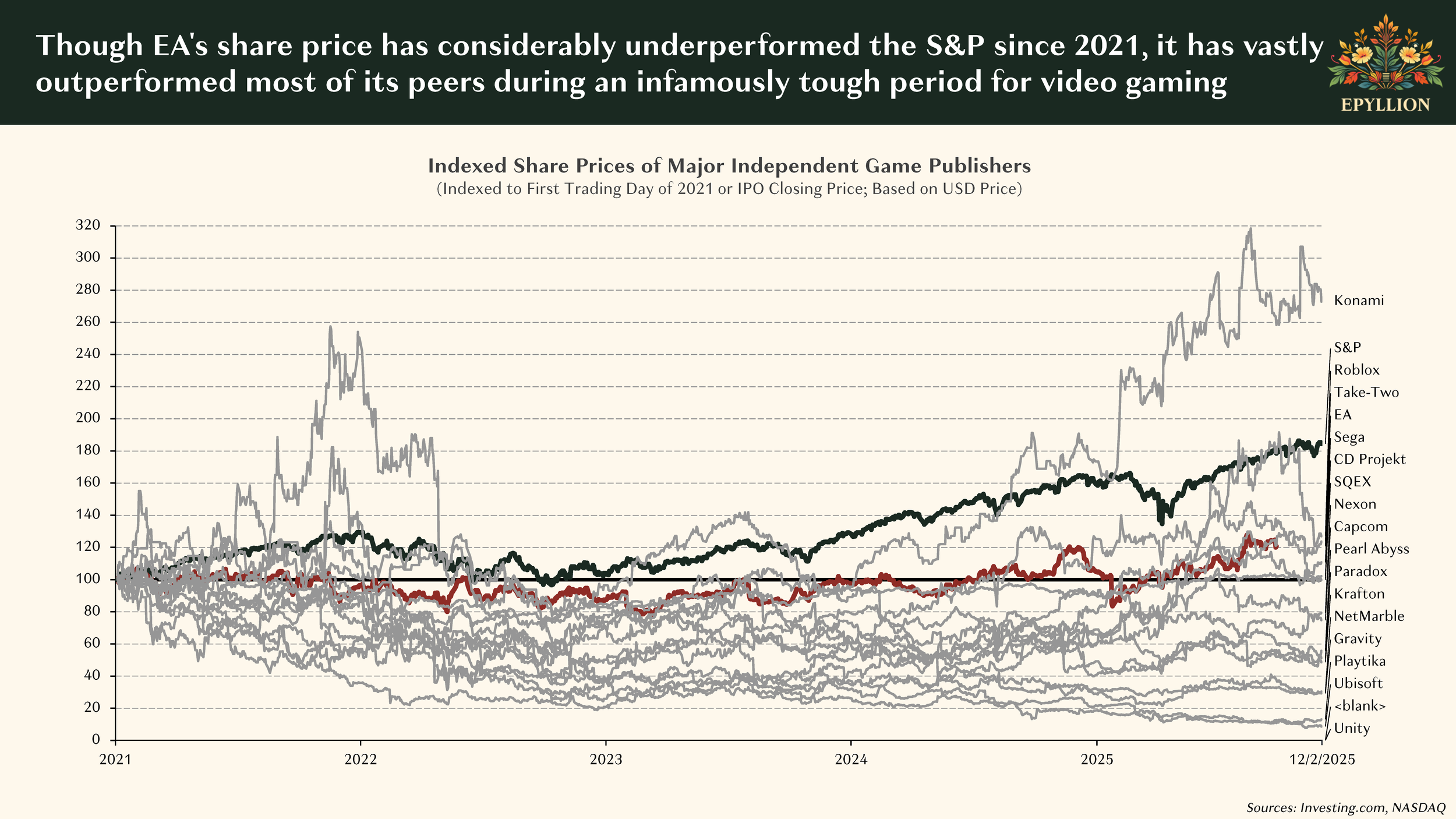
By going private, EA has the opportunity to do All The Things that are typically associated with a private process and that can help address the above. Yes, some of that is probably a substantial restructuring, which was presaged by the company’s unprecedented public embrace of generative AI at its Investor Day in 2024. But going private also helps EA make more speculative and longer-term investments. Some of these bets are in EA’s game development pipeline (remember, it has never been harder to launch new titles, let alone new IP, and AAA games are only getting costlier to make, requiring more time to make and receiving more scrutiny at launch). Some of its bets are in technology (the company is working on a suite of generative AI capabilities including “no-code UGC,” LLM-powered NPCs, the reproduction of live sports footage into in-engine game experiences, back-end tools, etc.). And some bets seek to harness Generative AI (and other innovations) to make entirely novel game experiences, rather than just bigger, newer, or cooler-feeling updates to the existing ones.
EA does not need to be private to achieve the above, but it’s harder to please (and appease) scores of shareholders focused on quarterly results and industry multiples than a single investor (or group) with a clearer view and firmer commitment to a long-term plan that can more reliably digest the occasional whiff and flop along the way.
And so the Occam's Razor answer to “What’s the Business Case for Buying EA at $55 billion” is that EA’s investor syndicate believes that EA is poised to become far more valuable in the coming years than EA’s current investors do. And by taking the company private, investors believe that EA can more likely achieve its current plans and even exceed them.
Note, too, that EA (and its financial advisors) have significant “Business as Usual” expectations for the future. This starts with the current fiscal year, FY2026, which ends March 31, 2026. EA expects net bookings of $7.85B, 4.5% above FY2022 (the company’s all-time record), and an increase of 6.7% over FY2025 (which ended last March). Moving forward, FY2027 then grows another 5.1%, with FY2028 leaping 21% to $10B. The 2028 jump would be just 3% shy of the company’s 24% year-over-year jump during COVID, but 28% larger in dollar terms. Put another way, EA’s revenues declined 2.1% in FY2022–2025, but in FY2025–2028 EA is expecting growth of 35.9%, with the years after that to average +4% annually. Adjusted EBITDA grows even faster, up 104.5% in FY2025–2028, having shrunk about 5% from FY2022–2025.
These are lofty forecasts and largely inscrutable (EA has not publicly detailed which franchises, new games, and strategies will deliver such enormous top-and-bottom-line growth, including 2028’s massive hike). And to be clear, these projections have been prepared by EA in an effort to sell at the highest price possible. Yet EA is testifying to these very numbers while trying to convince current shareholders to sell now rather than stick around for what management expects to be quite a ride. PIF, Silver Lake, and Affinity don’t necessarily buy into these exact numbers, but they obviously liked them enough to buy the company!
But if the price that PIF, Silver Lake, and Affinity are paying for EA partly—well, let’s say mostly—reflects these lofty expectations, what is needed for the investor group to generate a return on that 25% premium?
First, if EA achieves these figures, there will be a return. The agreed-upon price of $55B is discounted for the uncertainty and risk associated with EA’s current plans. If they are achieved, or mostly achieved, the company will be materially more valuable. The take-private process is also supposed to improve the odds that EA can realize its potential (and probably greatly increase it, too). The investor Group is also financing only $35B of the $55B deal with equity; the rest is made up of debt that, in success, will goose equity returns.
But irrespective of EA’s ability to become a More Lucrative Video Gaming Giant, I suspect there is a bigger idea behind PIF, Silver Lake, and Affinity’s bet on the company. It may not be necessary for the purchase to make sense. It’s also harder and costlier and sits outside EA’s core skill set of game development today. But it certainly seems to fit the goals of EA’s chief new backer, PIF, which would own a reported 93% of the company, and the fairly transparent non-gaming interests of EA. And oddly, it remains basically ignored outright by deal coverage thus far.
KICK OFF
EA is an intense and vocal believer in the convergence of interactive and linear entertainment. It’s no coincidence that EA’s two closest exits over the last decade were both mergers (at least in name) with media companies that operate large live sports platforms — namely, Disney’s ESPN and NBCUniversal’s NBC Sports — rather than just traditionally linear IP such as Star Wars or Game of Thrones. More recently, EA has spoken at great length about building a community and content platform around their games’ cores — while specifically highlighting there are 265MM people in EA Sports player network, but 4B+ who “play, watch, compete, connect” in sports.
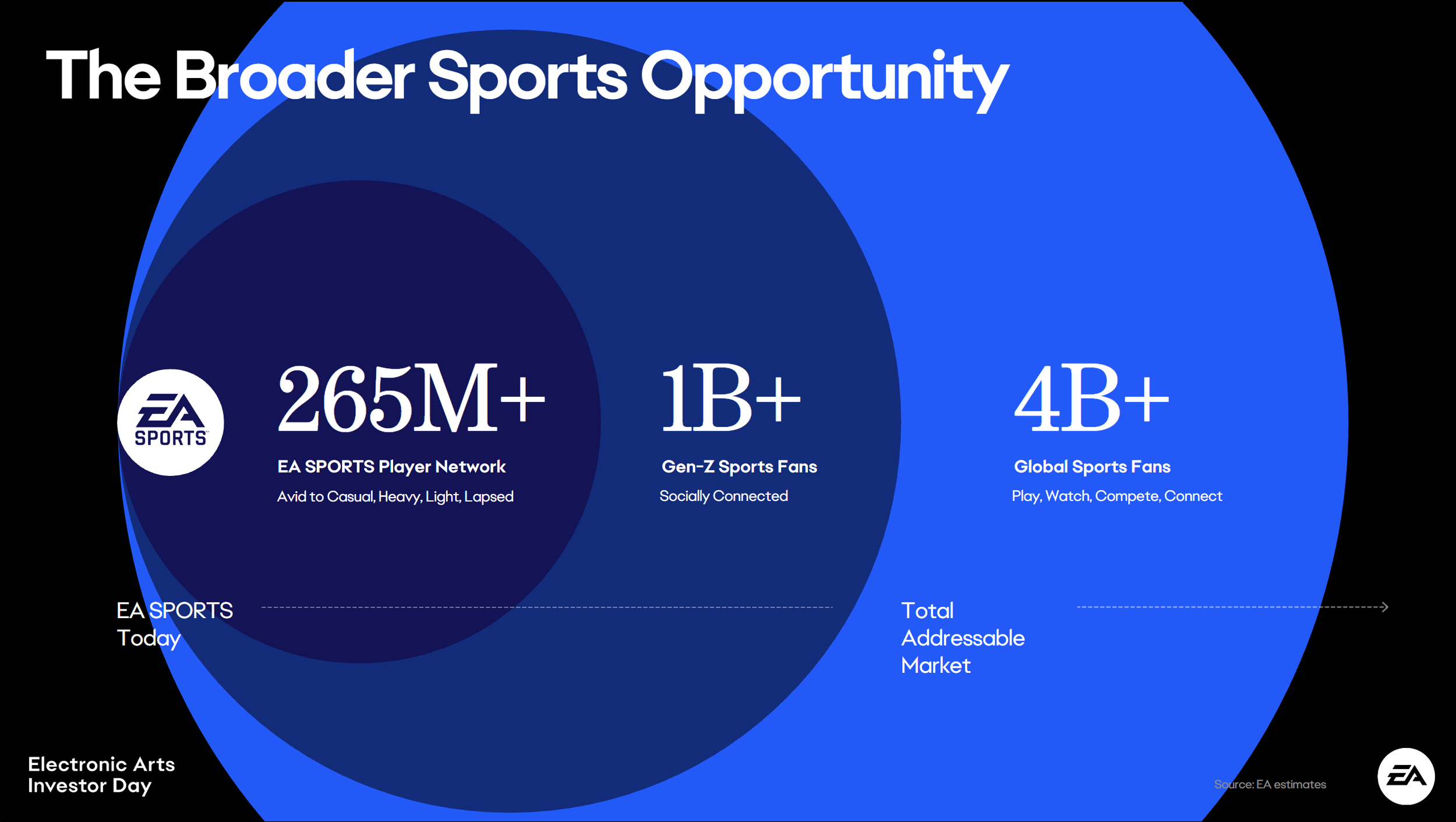
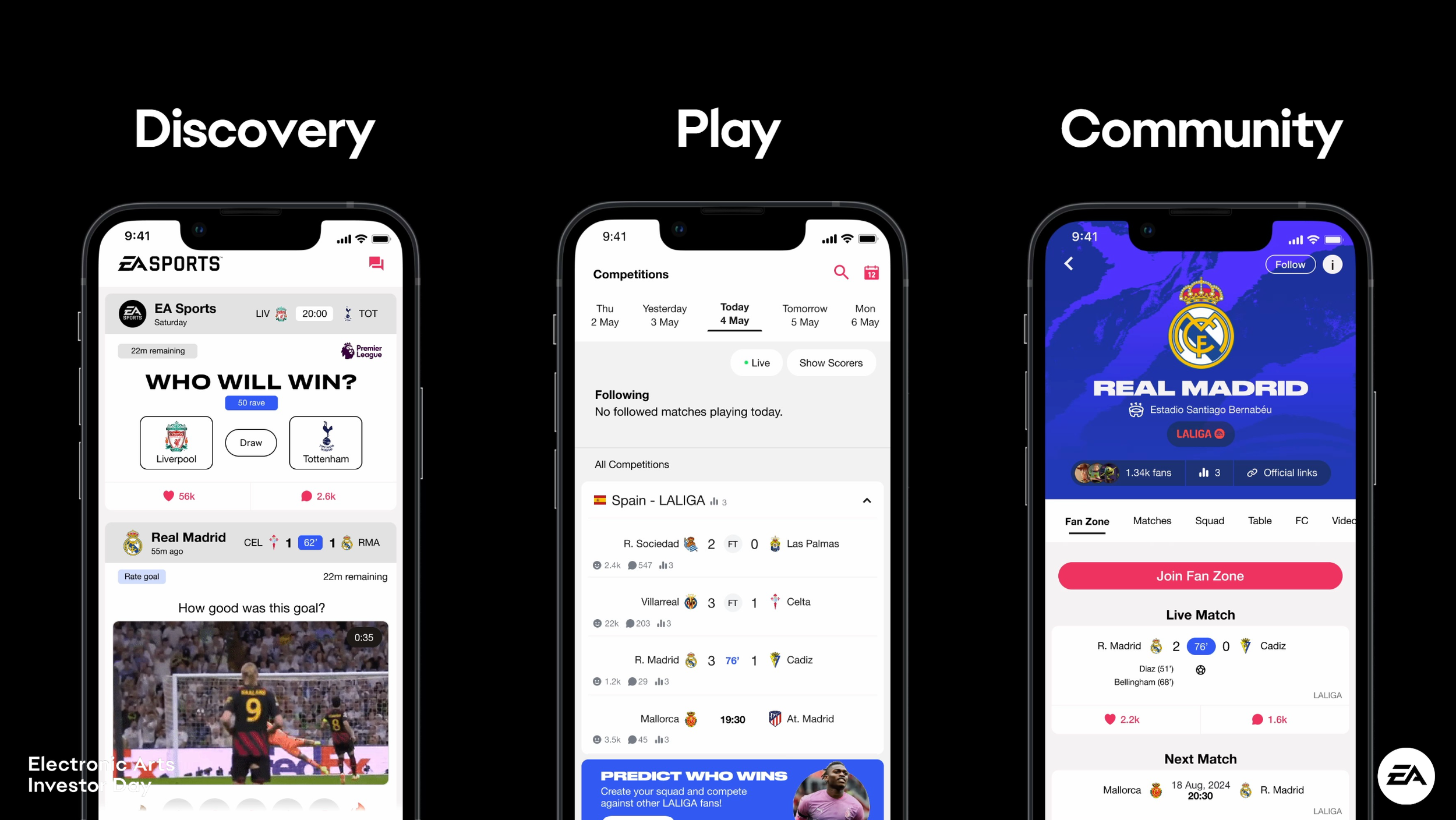
In support of its “5 year ambition” to reach “massive online [football] communities” and then “expand into Broader Sports Market,” EA recently relaunched its EA Sports Mobile App to include real-world live game scores, the ability to vote on the player of a real-world match or predict the contest’s eventual winner, and related social/community features.
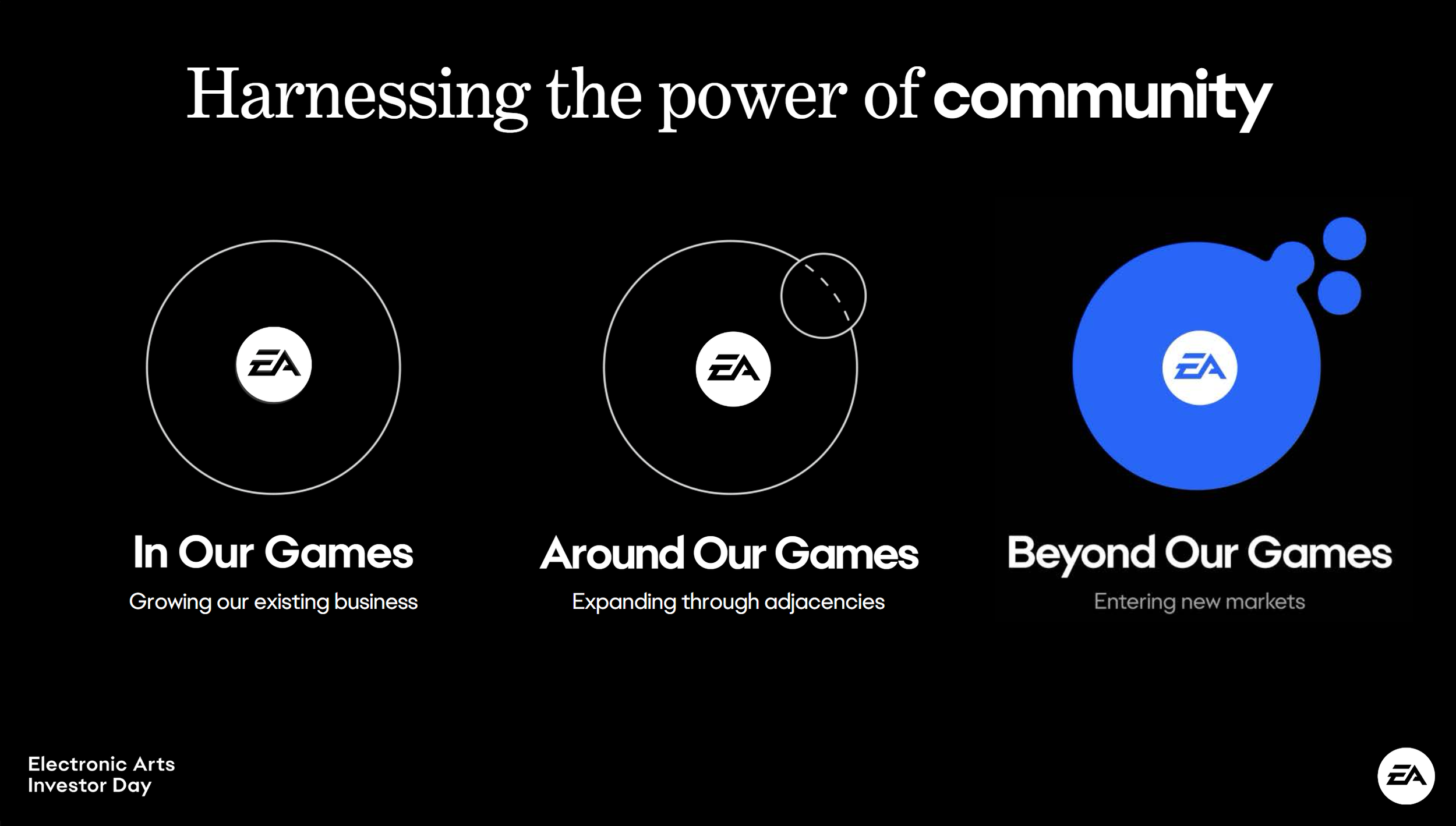
It’s likely that EA hopes to add fantasy sports to the EA Sports Mobile app and maybe even sports betting integrations (and prediction markets?). The latter might sound radical, yes, but such a partnership was once considered inconceivable at an institution like The Walt Disney Company, too. But after returning to the helm of the company in 2022, Bob Iger concluded that the eventual union of sports viewing and betting was “inevitable.” According to the Wall Street Journal, “Iger reasoned” that “getting involved with gambling was the only way to ensure that ESPN is able to continue to attract younger audiences.” In 2023, Disney announced it would license the ESPN brand to Penn Entertainment’s sportsbook for $2 billion over a decade. Today, ESPN’s sports broadcasts are littered with betting odds and filled with on-air discussion of them.
Another touted EA feature is Highlighter, which reproduces real-world games inside EA’s real-time game engines so that players can “play every moment” or watch a given match from any angle, following any player, or from any seat in the stadium. Want to see if you can make a kick Messi couldn’t? Or make use of a pass from Ronaldo that Benzema muffed? You’ll eventually be able to.
Highlighter connects to another touted growth opportunity for EA that goes “beyond the game” – Predictive Simulations. EA says that its “pipeline of real-world data, both stats and volumetric, combined with our game AI and IQ system” enables the creation of altogether new forms of sports entertainment experiences. For example, consumers will be able to test (and, one would imagine, eventually watch or, er, “watch”) AI-generated answers to questions such as “Who would win, the ’85 Bears vs. the ’07 Patriots?” or “If they were in equal machinery, would this season's F1 champ be Lando or Max?” or “Would Prime GSP beat Prime Khabib?” or “Who will win the SEC Championship this Sunday?” or “Did Lionel Messi over- or underperform in the last match?” Successfully executed, Predictive Simulations has utility in fantasy sports and sports betting and applies not just to professional sports but also to amateur and youth sports.
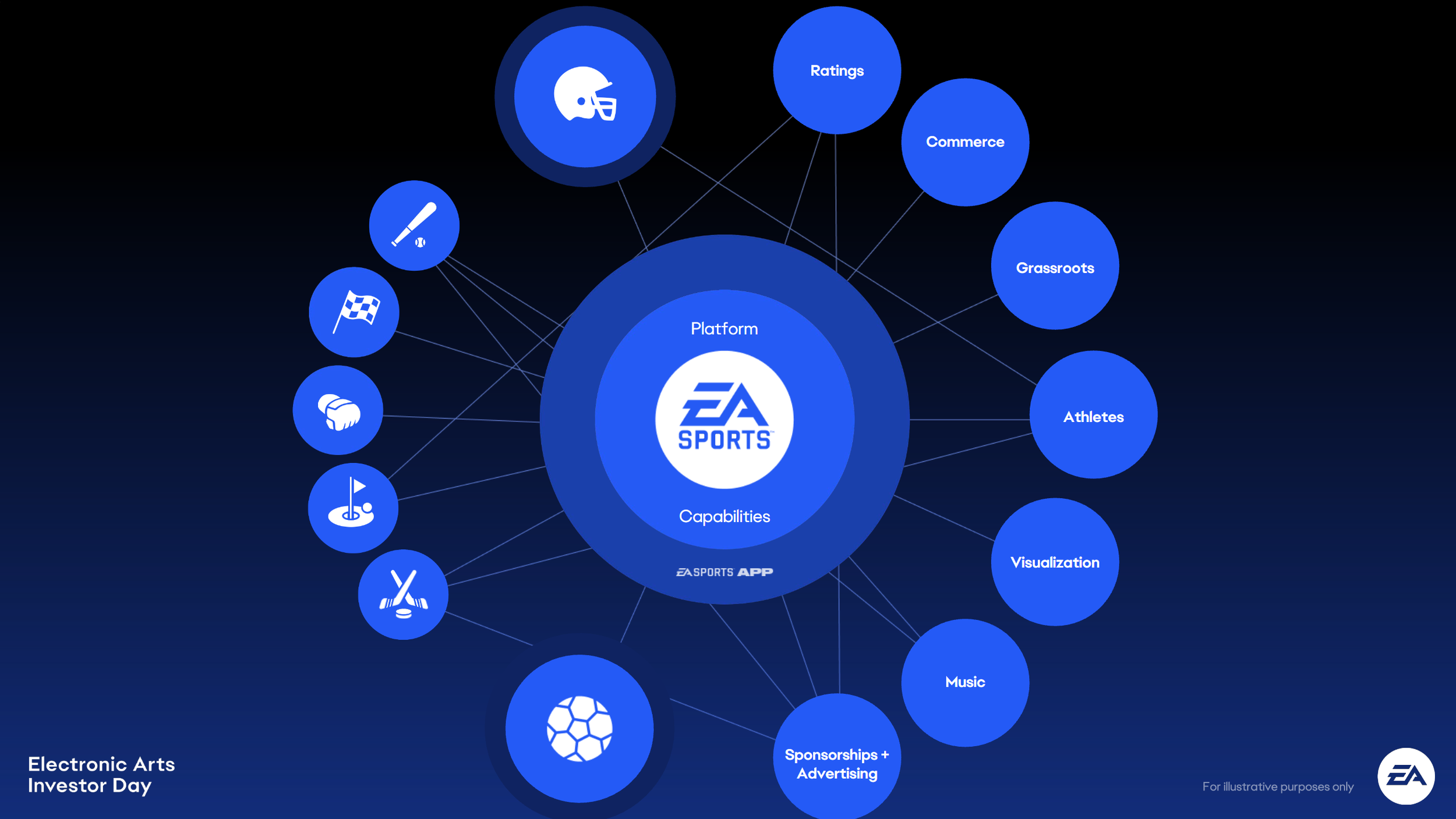
The clearest demonstration of EA’s ambitions came earlier in 2025 when the company secured a deal with MLS and Apple TV to distribute four live MLS games inside the EA Mobile app. Not coincidentally, these broadcasts occurred just a few weeks after the EA group initiated formal discussions to sell the company to the aforementioned syndicate.
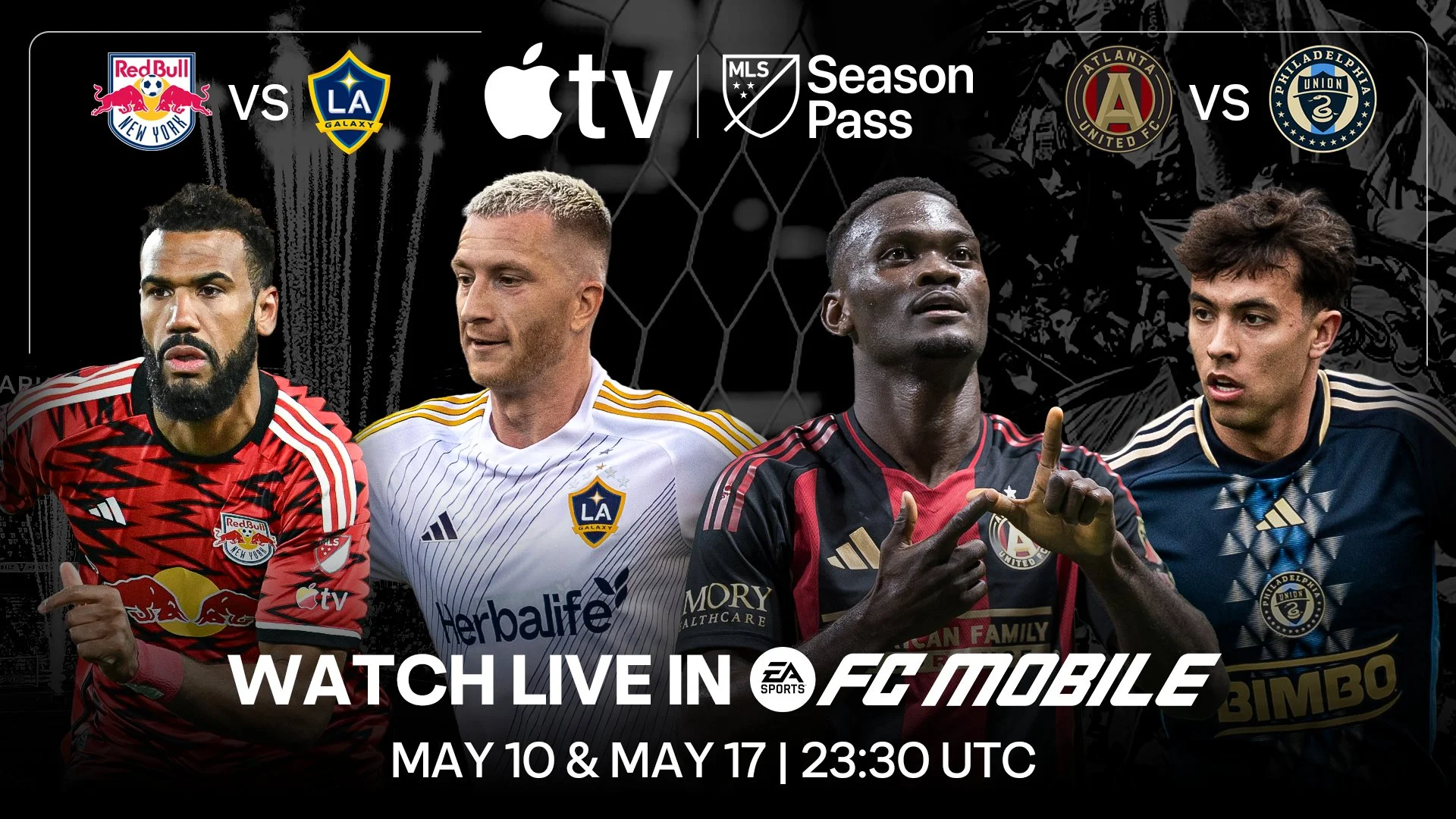
Taken together, one has to imagine that EA, with the backing of some of the most powerful and deep-pocketed funds in the world, hopes to buy/distribute traditional live sports rights and then augment it with interactivity and surround it with myriad other community features in order to generate more direct and indirect revenue than non-interactive rights buyers might achieve.
Might the Saudi League be distributed globally by EA by the end of the decade? Keep in mind, Saudi Arabia is hosting the 2034 World Cup, Ronaldo is the captain of the Saudi League’s Al-Nassr FC, and Messi is an “official tourism ambassador” for the Kingdom. Which other leagues might EA Sports pursue? Well, the official name of Spain’s top football league is currently... LaLiga EA Sports (yes, actually). Why buy the interactive rights to players and clubs and real-world matches and data and the right to rename the league… but not the match distribution rights itself? Consider that in recent years, Apple and Netflix have fought over F1 rights. Might a Saudi-backed EA, publisher of EA F1, be the next contender?
One of the telltale traits of sports rights forays is that they are exploratory and judicious. Amazon now spends over $3 billion a year on live sports, much of which goes to exclusive marquee and exclusive rights, but its foray began with an relatively timorous $50 million dollar investment in non-exclusive rights to the NFL’s Thursday Night Football games in 2017.
In success, the expansion into live sports would be of enormous strategic value to EA. The most straightforward benefits are greater cross-promotion as well as richer and more extensive integration between linear and interactive products. This is particularly important in categories such as live sports data, fantasy sports, betting, and ecommerce/merch, each of which is brutally competitive, low in margin, and highly reliant on user acquisition expenses. But, as mentioned, one of EA’s key profit limitations has been its royalties to leagues, teams, and players, and the company’s overall valuation is further hindered by the overall reliance on various deals with these same parties. By extending into live sports directly, EA can offer (and thus also demand) unique value to leagues and their stakeholders. Note that earlier this year, EA announced plans to follow up its hit EA Sports College Football relaunch with EA Sports College Basketball in 2028… only to quietly cancel the plan a few months later after Take-Two, which produces NBA 2K, secured de facto blocking rights with key Division 1 schools.
Of course, expanding into live sports is a very long game — and very costly, too. But it also has massive upside with clear enough business cases — and only a few media and technology companies can afford it. Such an expansion would also explain the perceived necessity (or at least value) of the take-private process — especially one with such deep-pocketed backers who value not just the P&L of a business but its cultural impact, too.
Matthew Ball (@ballmatthew)